Free Jazz,from the wilds of Boston and the African American core in New York City. Icons among us, working stiff sonic yeomanry, Avante garde upsets and the hazards it ever endures
By Eric Zinman. First published in FEMEFICATIO UK in 2012. (originally edited by Kamaria Muntu and Malkia Charlee Martin) Linda Sharrock is sitting today in a wheelchair after having suffered a stroke. She is disabled from motion and words literally, without action, flabbergasted. She, however, is still on a mission. An eloquent, artistic, and authentic musician who began her career in partnership with jazz guitarist and husband Sonny Sharrock. Her impressive vocals on the album Black Woman produced by Herbie Mann on Atlantic Sub Vortex and released in 1969, heralded the arrival of a cutting edge talent to be reckoned with. She now finds herself embroiled in a complex domestic drama. In a fight for her own autonomy, property and the financial wherewithal to heal properly. But even in this tragic complexity which must be sorted if she is to survive. She is yet determined to work, to tour – to reclaim the artist in herself and her place in the world of avant-garde jazz.
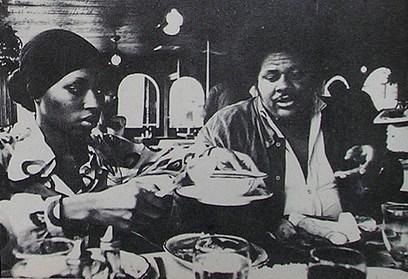
Linda and Sonny Sharrock, 1970s
“America always made it a point to keep the creative arts low down” was a phrase I heard during the 60’s ... But I never had a precise idea what the expression low down might actually represent until I learned more about it – witnessing closely the infamous fate of Linda Sharrock and her literal human, physical and artistic destruction ... Now I know.” (Mario Rechtern, musician and Linda’s caregiver).
After a tumultuous year Vision Festival seeks to imagine a world without Roy Campbell and Amiri Baraka.
Arts for Art Presents
VISION FESTIVAL 19
Studies In Freedom
Wednesday June 11 thru Sunday June 15, 2014
At Roulette, 509 Atlantic Ave, Brooklyn, NY
Honoring Legacy of Amiri Baraka
Since the first Vision Festival, in 1996, Amiri Baraka has been an important presence at Vision. For many of the other artists and audiences who have participated each year, Baraka has been an inspiration. For the last five years Baraka helped organize the panel discussions. This year, we not only wish to pay tribute to him by acknowledging his importance, but we also are looking to him for inspiration to continue the struggle and not become complacent.
WEDNESDAY, JUNE 11 Celebrating LifeTime of Achievement Charles Gayle
7:00Charles Gayle Trio + Dance
Daniel Carter – reeds, Miriam Parker – dance + Guest
Charles Gayle – bass & piano, Michael T.A. Thompson – drums
8:15Charles Gayle Quartet
Charles Gayle – tenor, Dave Burrell – piano
William Parker – bass, Michael Wimberly – drums
9:15Quincy Troupe reading from the work of Amiri Baraka + his own poetry
9:45Charles Gayle & the Vision Artist Orchestra
Charles Gayle – piano, conduction
Kidd Jordan, Hamiet Bluiett, Ingrid Laubrock – sax
Ted Daniel – trumpet, Steve Swell – trombone
Jason Kao Hwang, Mazz Swift – violin, viola
Nioka Workman – cello, Shayna Dulberger – bass
Andrew Cyrille – drums
THURSDAY, JUNE 12 Celebrating musicWitness® Jeff Schlanger
6:30 CHILE•NEW YORK•AfghanIRAQ by Michael Lucio Sternbach
FILM the work of Jeff Schlanger Music by William Parker & Roy Campbell
7:00 Steve Dalachinsky reading from the work of Amiri Baraka + his own poetry
7:15 Wimberly’s Harlem Ensemble ‘Signs & Rituals’ Michael Wimberly – drums, percussion, Antoine Roney – tenor & soprano saxophone Larry Roland – bass, Nioka Workman – cello
10:15 Peter Brötzmann + Hamid Drake + William Parker Peter Brötzmann – reeds, Hamid Drake – drums, percussion, William Parker – bass
FRIDAY, JUNE 13 FROM SPIRIT TO SPIRIT – honoring Roy Campbell
4:30 Panel: The Legacy of Amiri Baraka: Art in Action: Part 1
Cultural Identity / Self Empowerment / the role of Free Jazz
A retrospective in the First Person Moderator: Mike Burke Democracy NowPanelists : Oliver Lake,William Parker, Jason Kao Hwang, Mazz Swift,DD Jackson, Fred Moten
7:00Whit Dickey Quartet
Whit Dickey – drums, Mat Maneri – viola, Michael Bisio – bass, Rob Brown – alto
8:00Ramya Ramana Poet – reading her own work and that of Amiri Baraka
8:15Women with an Axe to Grind
Kris Davis – piano, Shayna Dulberger – bass Mazz Swift – violin, Patricia Nicholson – dance, words, rhythm
9:15 Jemeel Moondoc QuintetJemeel Moondoc – alto saxophone Steve Swell – trombone, Nathan Breedlove – trumpet Hill Green – bass, Newman Taylor Baker – drums
10:15James “Blood” Ulmer Music Revelation Ensemble revisitedJames “Blood” Ulmer – electric guitar Calvin “The Truth” Jones – bass , Cornell Rochester – drums
SATURDAY, JUNE 14 A FUTURE OF VISION (Honoring the Next Generation)
12:30 Forum on : The legacy of Improvised Music
Dave Sewelson, Connie Crothers, T.A. Thompson, Lisa Sokolov, William Parker
2/ 4pm Music Is Mine Music Program
3:45 All students (70 musicians) under direction of Jason Kao Hwang + guests
4:30 Panel– The Legacy of Amiri Baraka: Art in Action Part 2
Part 2 - Decolonizing the Music: The conversation continues:
Moderator: Basir MchawiPanelists: William Parker, Juma Sultan, Ahmed Abdullah, Brent Hayes Edwards, Hamid Drake, Fred Moten
6:00Fay Victor + Tyshawn SoreyFay Victor – voice, Tyshawn Sorey – drums, percussion, found instruments
7:00Jordan + Burrell + Parker + DrakeKidd Jordan – tenor saxophone, Dave Burrell – piano William Parker – bass, Hamid Drake – drums, percussion
8:00 Poet David Henderson reading the work of Amiri Baraka + his own poetry
8:20TIMES THREE Connie Crothers – piano, Henry Grimes – bass, violin, Melvin Gibbs – electric bass
9:30Roy Campbell Tribute Band led by Sabir MateenSabir Mateen – reeds, conduction, Rob Brown – alto saxophone Daniel Carter – reeds, trumpet, Dennis Gonzalez – horns Andrew Bemkey – piano, William Parker – bass Hamid Drake – drums
WHEN Wednesday, June 11 thru Sunday, June 15, 2014
WHAT3 Panels Honoring The Legacy of Amiri BarakaJune 13, 14, 15
Each Night a poet will read from the words of the Great Amiri Baraka
6/11 Quincy Troupe, 6/12 Steve Dalachinsky, 6/13 Ramya Ramana,
"My first response upon hearing that you requested a press pass to write something about the evolving series was, No way. I said, make Howard pay, because I know what he writes is going to be more detrimental than helpful. Then I said good or bad, it is publicity for the series and the musicians. Lo and behold the review come out and it is, as usual, a display of marginalizing the music, the musicians and the taking stabs at the non-profit producer, Arts For Art. This article showed me that you are still a chop shop groupie who kisses the ass of those you think are important, and you associate with them to further your career and bask in Their glory. For those who can't or choose not to support your dream of self importance, you dismiss.
But as Sunny Murray says “The conquest has been Coned but not Won”. It is 2014. I would have thought by now you would have clue about how improvisational music works. Then again, some people live and grow and some people walk around with their head up their own ass.
There is so much more in the phrase, “play what you feel” then you will ever understand. It takes years and years of practice to develop a sound and language on one’s instrument, training oneself how to improvise and how to compose on the bandstand. Do you know what makes Daniel Carter special? Or why is Rob Brown called the epic poet of the alto saxophone? What are their innovations? Howard, your article showed your ignorance, sublime stupidity, and that big chip you have on your shoulder against Art For Art. It is obvious that you don’t understand or get the music you heard.
You have boosted over the years that you have helped us and helped the music. All I can say is you are definitely delusional. With help like yours the music would have died long ago. It is the musicians and music that sustains the music, not your lame writing, or periodic radio broadcasts from the past. Your efforts have always been blatantly self-serving. I have spoken with many well-known Musicians about you and the conclusion I get is they have no respect for you. The musicians from Chicago think you’re a clown. The St. Louis musicians think you’re a creep. The general consensus is that I shouldn’t even bother responding to anything that you have written.
I read your book on Cecil Taylor/ Ornette Coleman and Miles Davis/ the book was horrendous and uninformed unless it was supposed to be a form of science fiction comedic writing.
I want you to know that if you ever get assigned by any magazine to write about the Vision festival or any concert that is produced by Arts For Art. You will not be welcomed. You are banned from entering any event. And, if you see me at a social event, please stay away from me. Don’t write about me, or talk to me, or nominate me for your ridiculous jazz journalist award.
You don’t like what we do and we certainly don’t like what you do. you are blind, unable to see the darkness or the light.
I will be sharing this email with the public just as you shared your review ."
William Parker.
Good old William. The Pudgy Dunce has been insufferable, glib and useless forever. Astuteness from Stanley Zappa follows. "The thing about this particular argument is that it is never accompanied by a solution, or even a direction in which the final solution to all the "problems" of this music can be found. Is it to be found in written lines, well rehearsed, shoulder pads in the yellow jackets (jack-its)? What does Howard like to listen to?"
One of the more pernicious problems afflicting the core community turns on certification. On the surface this is easily ridiculous and should be. Beyond traditional peer review, most musical idioms outside the purview of formal institutions aren't subject to much of a credentials process involving six figure price tags.
This credential fabrication is a connivance of gate keepers on the 'commerce' side and the educational side. Old media maintained a retinue of credential makers now increasingly bypassed by the ability to just click on a You Tube of the artist in question and decide for your own damned self.
Roy Sinclair Campbell Junior essentially gave his whole life to the music of his home community, the African American community, from his early days as a community college student with a Fletcher Henderson alumnus, Dick Vance.
From there he learned more trumpet craft from Lee Morgan. And so it went across the bright arc of his moments. Roy was the ultimate musical working stiff and roamed New York to find work in stage and show bands, parade gigs, probably even a fashion show or two, (it's an actual gig description item in the musician's union rate book). And through all that he kept faith with his world and participated to the greatest degree he could.
america is unkind to its heroes few streets with plaques few obscure country roads renamed i being ignorant historian will not even bother to name even one used to be that things used to be that way like being in a storm with no clouds to blame it on sketching perfect stories flag folded into a neat triangle beckon / become these strings that thought: lament remaining full / brought toward your chin exhaled blown away expelled / womb emptied out of guts & self inhaled
& now American hero you are in someone else’s hands in a system far far away yet connected always to HERE & the thirst one feels of apprehension when apparitions appear the thirst one feels / the thirst one has for comprehension the death of metaphor but not of soul
if everything we do is in the past then all our conversations are memories about to happen & though you are gone your spirit has not even begun to touch down rest & reside here in the present in the past in the future which is your music & your passion your occupation & your light so it would seem then that we have unlimited time in the past which is now to gather & to speak / to make music & to sing illuminating – warrior – translator of emotions - to those who knew you – soldier now M.I.A. – unpredictable big sadness awaits us – big joy from your SOUND your art a postcard of the world – its beauty – its horror – its tenderness - its ferocity you had a way of opening up the silences from within – cluttering them with form – taming then unleashing language – twisting it in & out – your train of thought never drifting from your purpose - the hardship of battle & the spaces between things
you no longer wait to be pulled away – the deities claim you now welcome home hero – to a new birth every day - the clouds & birds possess you now all manner of clouds & birds to praise the great upheaval that your music brings bottled the way our dreams are - the way things reach us the way we inhale & exhale the lyrical night
the way the music so sweetly assaults us from so many different directions surrounding us with an aura of freedom that seeps into our blood beyond ailments / pain &; bones - inside our life - as we grow “older” sometimes weeping for the happy crowd
i could sing all day about the passing storm tiny explorations of the horizon the way the wind pronounces its name during the aftermath limping home at war’s end / this never ending war
so march on / march on a city is only as good as its music your music filling the city’s voids & chaos’s city boy from the country this will always be your home & the song that sometimes comes out wrong is always right - so you do it your way & i’ll do it my way & this way it becomes a thing. mine. yours. ours. memory’s. time’s.
Between 1987 and now Matthew Shipp has made duets with wind players a recurring pursuit to the point where there are a number of recordings and examples of these focused and fascinating benchmarks of his elaborate participations and contributions.
The earliest recorded one was a document of a collaboration with a friend. Several are projects where Mr. Shipp was specifically engaged to bring his potentials to a colleague.
Others follow the original plan and come from affinities and friendships strikingly shaped as sounds.
The summary of these duets makes the counterpart participants and their various roles the focus. Mr. Shipp is true to his essential outlook and aim throughout so a listener mainly follows the arc of his discoveries and excursions.
It all rests on ground of an easy familiarity with all that has preceded him and rises to seeking with each waking day. It is the search of the intrigued and wonder based outlook where a piece grows from some kernel or other and shifts as a stream runs its course. He covers drums, bass and a counter voice to his wind rooted counterparts with a powerful and alert suppleness.
The highly portable and concentrated mini ensemble form that is a piano and wind duet has been a Shipp focus since he roamed Jordan Hall, at least.
The upper floors of Jordan Hall then were full of small piano practice rooms. The most readily available ones are too small for an ensemble or even an upright bass but a horn player can fit in. Matthew generally has a charitable and warm regard for pianos and will cut em slack if they work reasonably well. Sure, in a fair and thoughtful world he’d mainly be working high end Steinways and up but why let a little thing like humble provenance and a bit of wear get in the way?
In a life often reduced to a blur of flights, train trips and bus rides over the rind of the spinning globe, a piano, for Mr. Shipp, is home. When he arrived here on Mothers Day, he embraced the gallery upright the minute he got there so the flow of conversation met a stream of Ellington channeled as a spirit more than a structure.
Where others before him have been known to fuss mightily over breaking through boxes to offer up monumental edifices, he prefers to let the moment make the structure, to let the stream course shape the shore.
And so it was that a Piano and Saxophone duet became a valuable way to model sonic teamwork and ensemble dynamics. Practice room access wasn’t too restricted and the cat herding that attends getting a drum and bass involved was removed as an issue. There may be an early example of these duets from 84 to 85 involving Gary Joynes at the Brandeis Radio Station series, World Class Jazz at the Joint. The search is ongoing.
“ How motion hereby is sensed in the minutae of tones”
“implication dominates how rhythms and pulse function more for their coloristic value than as velocities in a metric framework. Sounds are juxtaposed to intervallic sense, one to another so that the focal point of any passage is its direction rather than a tonal center”
-Ben Young-
“A musicians is more than a person who plays an instrument. The musician is an engineer of sound and should utilize any and every aspect of sound in the production of music"
Musician/Composer Jimmy Stewart-
“every instrument encompasses an orchestra”
-Musician/Composer Bill Dixon –
All these comments summarize concepts that some musicians have been developing since the 60’s. Unlike many of the revivalist tendencies of today, the “jazz musician” (to use a common reference term which still has pejorative implications today) was formerly defined as someone who played the instrument like no one else.
Bill Dixon’s personal approach and mastery of the trumpet is rarely discussed in the United States. His brilliance and purity of sound is compelling. The sudden tutti entrance is a fitting first take. Here are beautiful phrases constructed of fourths and fifths embellished by warm scalar colorings, poignant changes in register, and a modality not unlike the work of Miles Davis and John Coltrane particularly in the way Mr. Dixon can reduce a musical event to one sound or a few slow notes contrasted with evocative silences and compressed phrases.


.JPG)


